We pulled a set of panels off a roof in Pearl City last year. Fourteen years old, budget-brand polycrystalline, installed by a company that no longer exists. The homeowner thought they were still producing close to their original rating. They were not. Monitoring showed the array was down to 71% of nameplate. That is not unusual for cheap poly panels in Hawaii's climate. It is also not inevitable. The technology inside the cell determines how fast your panels lose power over time — and the difference between the best and worst options is worth thousands of dollars over a system's life.
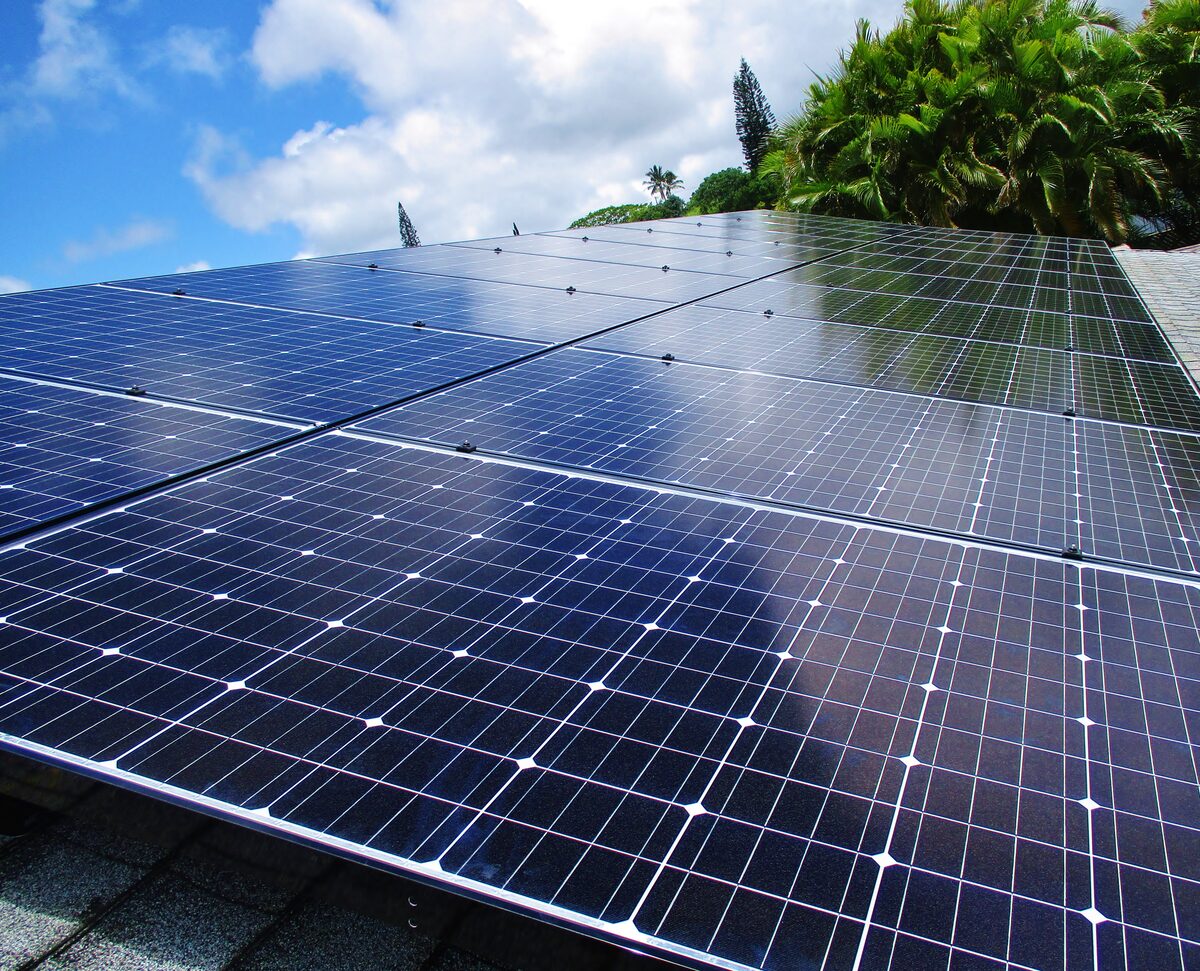
Every solar panel degrades. Slowly, irreversibly, from the day it starts producing. UV exposure breaks down the encapsulant materials that protect the cells. Thermal cycling — hot days, cooler nights, thousands of repetitions — stresses solder joints. Light-induced degradation (LID) reduces cell efficiency at the atomic level. This is normal physics, not a defect. The question is not whether your panels will lose power, but how much and how fast.
The Technology Gap Is Larger Than You Think
Standard mono PERC panels — the current industry workhorse — lose 1.5–2.0% in their first year as the cells settle through initial LID, then degrade at 0.40–0.55% annually after that.[1] By year 25, you are looking at roughly 85–88% of original output. That is decent, but not great.
HJT panels are in a different category entirely. First-year degradation is just 0.5–1.0% because the amorphous silicon layers resist LID. After that, annual degradation runs 0.25% or less.[1] At year 25, an HJT panel is still producing about 92% of its original rating. REC guarantees that number in writing for their Alpha HJT line[3] — the strongest performance warranty in the industry.
TOPCon falls between the two: 1.0–1.5% first-year loss, 0.35–0.40% annually after that, ending up around 88–90% at year 25.[2] The tunnel oxide layer provides real protection against the carrier recombination that drives degradation, though not quite as much as HJT's amorphous silicon sandwich.
Polycrystalline panels — the ones we pulled off that Pearl City roof — degrade fastest of all. First-year losses of 2.0–3.0%, annual degradation of 0.50–0.70%, and year-25 output around 80–84% in ideal conditions.[1] In Hawaii's heat and UV, the reality is often worse.
What That Costs You in Dollars
Take a typical 10 kW system in Hawaii producing 15,000 kWh in year one. With HJT panels degrading at 0.25%/year, that system produces approximately 14,100 kWh in year 25 and roughly 363,000 kWh over its full 25-year life. TOPCon at 0.38%/year delivers about 13,600 kWh at year 25 and 356,000 kWh total. Standard mono PERC at 0.50%/year drops to 13,100 kWh at year 25 with a 348,000 kWh lifetime total.
The gap between HJT and mono PERC is roughly 15,000 kWh over 25 years. At $0.40+/kWh, that is about $6,000 in additional energy value from the same number of panels on the same roof. That gap more than covers the modest upfront premium for HJT technology. It is not close.
Hawaii Makes Degradation Worse
Our climate is beautiful and brutal on solar panels in equal measure. Hawaii receives some of the highest UV radiation in the United States thanks to its low latitude and frequently clear skies. That UV breaks down EVA (ethylene-vinyl acetate), the encapsulant that protects solar cells, causing yellowing and reduced light transmission.[4] Premium panels use POE (polyolefin elastomer) encapsulant instead, which resists UV degradation dramatically better.
Heat is the other accelerant. Sustained high temperatures speed up the chemical reactions that drive degradation. We have measured cell temperatures above 70°C on dark roofs with poor ventilation — common in older homes where the original installer skimped on standoff height. Proper mounting with at least 4–6 inches of clearance allows airflow beneath the panels, dropping operating temperature 5–10°C and meaningfully slowing degradation. We learned this early in our career when we noticed systems on well-ventilated racks consistently outproducing identical systems mounted tight to the roof deck.
If you live within a mile of the coast — Ewa Beach, Kailua, Hawaii Kai, anywhere along the North Shore — salt air adds another layer of concern. Salt does not directly degrade the cells, but it corrodes frames, junction boxes, and wiring connections. Corroded connections increase resistance and reduce output. Salt mist deposits on glass surfaces, blocking light. Regular cleaning and corrosion-resistant hardware are not optional for coastal installations.
Vog is Hawaii-specific. Sulfur dioxide from volcanic activity creates an acidic haze that deposits on panel surfaces. It does not damage modern panel glass, but the film reduces production until it is cleaned off. Homes on the Big Island and windward Oahu during vog events need to plan for more frequent cleaning.
Then there is thermal cycling — cool mornings, hot midday, cooler evenings, repeated thousands of times over the system's life. Every cycle expands and contracts panel materials, stressing solder joints and cell interconnections. High-quality panels use multi-busbar or shingled cell layouts that tolerate this stress. Budget panels do not.
What You Can Control
You cannot stop degradation. You can slow it down.
Start with the panel choice. HJT and TOPCon panels from Tier 1 manufacturers degrade measurably slower than budget options. The technology difference is engineering, not marketing. Then make sure the installation is right: adequate standoff height for airflow, torque-rated mounting hardware, properly sealed connections. Schedule annual inspections and cleaning to catch loose connections, early corrosion, and soiling before they permanently impact performance. And use Enphase microinverters so you can track each panel individually. A sudden drop in one panel's output usually indicates a fixable issue — a dirty surface, a loose connector, a fallen branch — not irreversible degradation. Catching it early is the difference between a 10-minute fix and years of lost production you never notice.
Read the Warranty Like It Matters — Because It Does
REC's Alpha HJT panels carry a 92% output guarantee at year 25.[3] Hyundai's TOPCon guarantees 88.4%.[5] Budget mono PERC panels typically promise 84–86%.
Those numbers are conservative — most panels outperform their warranty. But the warranty tells you how much the manufacturer trusts their own engineering. The gap between a 92% guarantee and an 84% guarantee is not a rounding difference. It reflects a real difference in cell technology, encapsulant quality, and manufacturing standards.
When you are comparing quotes, do not just look at year-one production. Ask each installer what their panels will produce at year 15 and year 25. The difference between 0.25%/year degradation and 0.50%/year is roughly $6,000 in energy value over the system's life. In Hawaii, where every kilowatt-hour you generate displaces $0.40+ electricity from HECO, panels with lower degradation are one of the highest-return investments you can make. Start with the 25-year number. That is the one that determines whether your system was a good deal or just a good-looking roof.
Sources & References
- Jordan, D.C. & Kurtz, S.R., “Photovoltaic Degradation Rates — An Analytical Review,” NREL, 2012. NREL
- NREL, Compendium of Photovoltaic Degradation Rates — field data across panel technologies. NREL
- REC Alpha Pure-RX Series product specifications and 25-year performance warranty. REC Group
- IEC 61215 & IEC 61730, International standards for photovoltaic module design qualification and safety. IEC
- Hyundai Energy Solutions, TOPCon solar panel specifications and warranty terms. Hyundai Energy US
- U.S. Department of Energy, Solar Photovoltaic Technology Basics. DOE