Reduce your business energy costs with solar PV. The federal Section 48E clean electricity credit often reaches 30% for commercial projects meeting prevailing wage requirements. Combined with Hawaii’s 35% state RETITC and accelerated depreciation, solar delivers compelling ROI for businesses of every size.
Hawaii businesses face the highest commercial electricity rates in the nation. Combined with the still-available federal tax credit, commercial solar delivers some of the fastest payback periods anywhere in the country.
Under Section 48E, commercial projects that meet prevailing wage and apprenticeship requirements can often achieve a 30% federal credit. This alone can save a business $30,000–$300,000+ depending on system size. The phaseout begins at the later of 2032 or when emissions reach the statutory threshold.
Commercial solar qualifies for 5-year Modified Accelerated Cost Recovery. Combined with the ITC, businesses can recover 50-60% of system cost in the first year through tax benefits.
Lock in your energy costs for 25+ years instead of riding Hawaii's volatile utility rates. Solar provides budget certainty that HECO rates never will.
Demonstrate your commitment to Hawaii's 100% renewable energy goal. Increasingly important for customer and employee attraction in Hawaii's eco-conscious market.
Over 33 years, we've designed and installed commercial solar for virtually every type of business in Hawaii.
High energy demand, high savings potential
Large roof area, daytime peak usage
Massive roof space, ideal for solar
Budget-constrained, mission-aligned
Mission-driven, community impact
Common area + shared savings
Over 33 years, AEI has completed more than 137 commercial solar, AC, and electrical projects across Oahu. Our portfolio spans every major building type — from the Halekulani Hotel to Aiea Elementary to neighborhood churches and apartment buildings.
Large flat rooftops and high daytime energy demand make hotels ideal for solar. We have completed projects at major Waikiki properties including the Halekulani Hotel. Systems typically range from 100–300 kW.
We have installed solar and electrical systems at multiple schools across Oahu, including Aiea Elementary, Kaimuki Middle School, Nuuanu Elementary, and Hawaii Mission Academy. Schools benefit from PPA structures that require no upfront cost.
We have completed projects for more than a dozen Hawaii congregations — from Kailua Methodist Church to Kaneohe 7th Day Church to Waialae Baptist Church. PPA and grant-funded structures make solar accessible for tax-exempt organizations.
Multi-family buildings can offset common-area electricity — elevators, hallway lighting, pool pumps, parking lot lights. We handle HOA board coordination and structural engineering as part of the project.
Large unobstructed rooftops with metal standing-seam roofs are the simplest and fastest commercial installs. Clamp mounting means no roof penetrations. We have completed warehouse projects across Kalihi, Mapunapuna, and the industrial corridor.
From veterinary clinics in Mililani to pharmacies and auto shops, our commercial portfolio covers the full range of small and mid-size businesses across Oahu. Each project is custom-engineered for the building’s electrical load and roof.
Commercial solar has the most favorable incentive stack of any renewable investment in Hawaii right now.
Section 48E — often 30%
30% of total system cost as a direct tax credit. For a $200,000 system, that's $60,000 off your federal taxes. Can be carried forward if not fully used in year one.
Accelerated cost recovery
Depreciate the remaining system cost (after ITC adjustment) over 5 years instead of the system's 25-year life. With bonus depreciation, up to 80% can be claimed in year one.
Up to $500,000 for commercial
Hawaii's 35% state tax credit (HRS §235-12.5) applies to commercial solar with a cap of $500,000 per system — far higher than the residential cap. This is a major incentive for larger commercial installations.
Sell excess to the grid
Export excess generation during business hours and earn bill credits. Peak evening rates up to $0.329/kWh on Oahu with battery storage.
*Illustrative example. Actual savings depend on usage, rate class, system size, and tax situation. MACRS benefit assumes 21% corporate tax rate. Consult your tax advisor.
Commercial solar is not one-size-fits-all. The right design depends on your building, your roof, your parking lot, and your energy profile. Here are the three most common approaches we use in Hawaii.
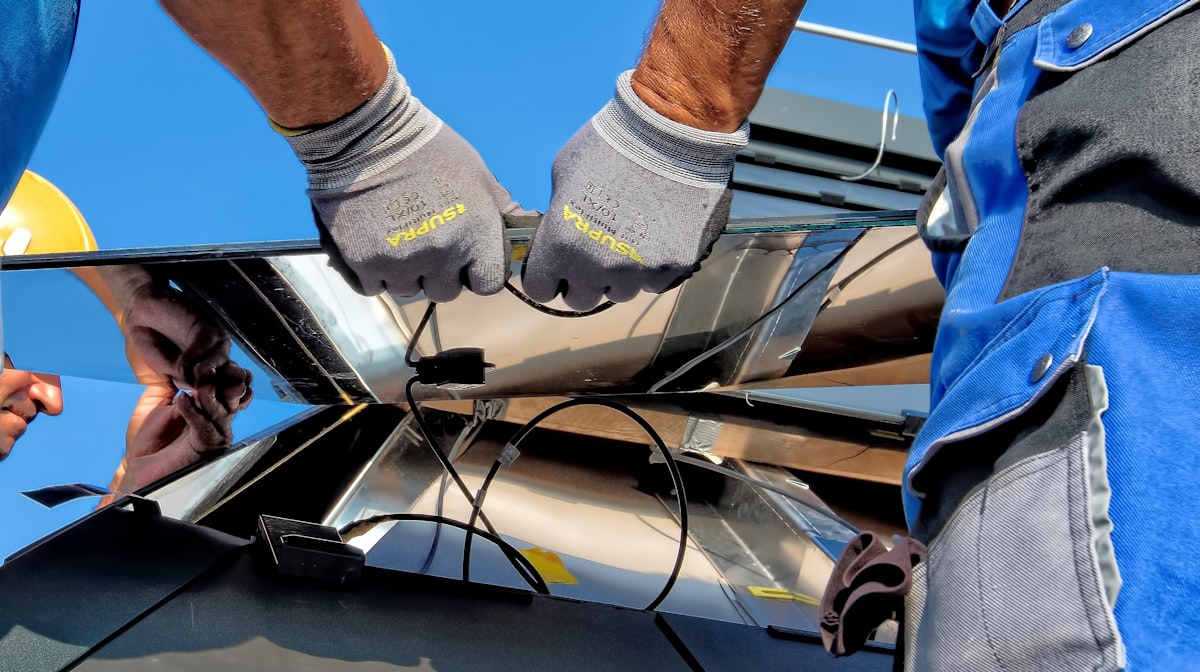
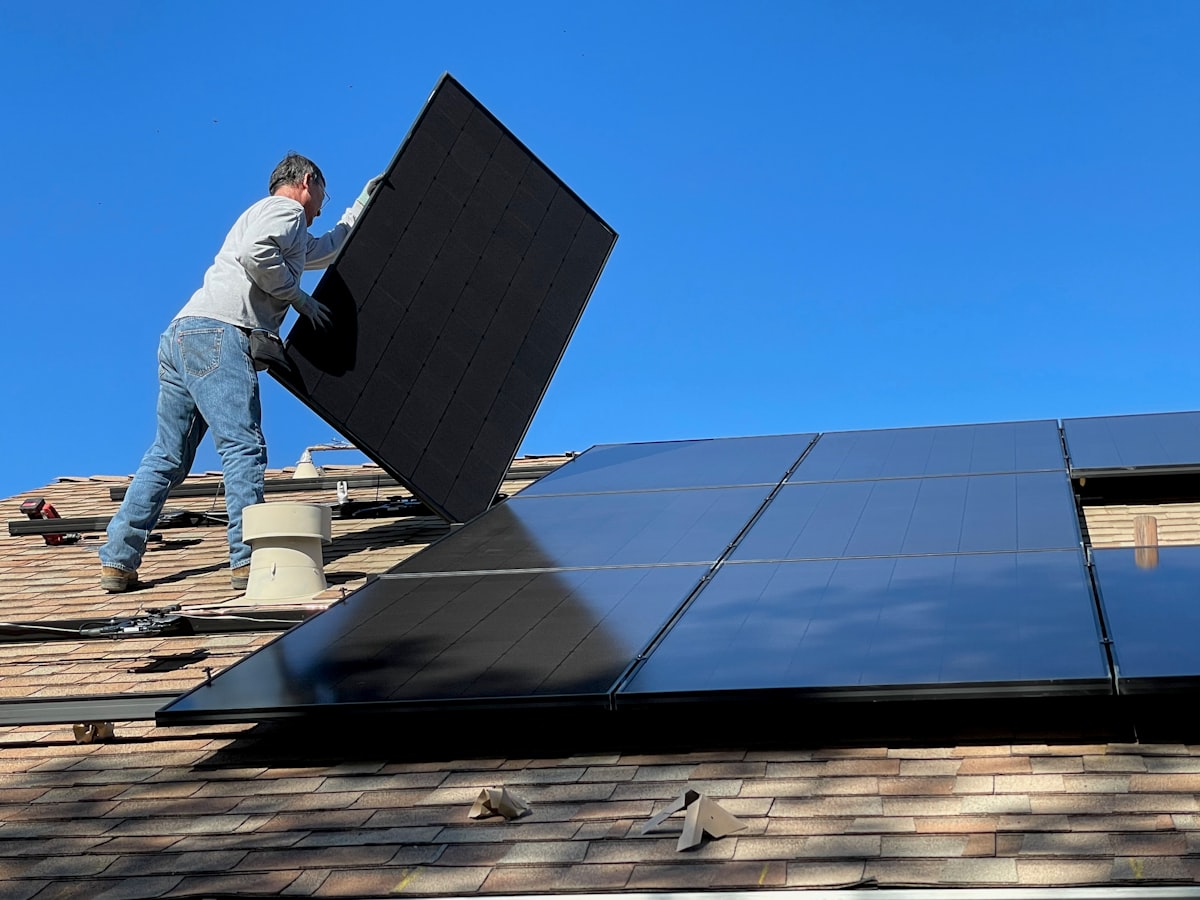
The most common commercial installation. Flat commercial roofs (warehouses, retail, office buildings) are ideal — they offer large unobstructed areas with no shading. On metal standing-seam roofs, we use clamp mounting that requires zero roof penetrations. On flat membrane or built-up roofs, we use ballasted racking or penetrating mounts with proper flashing.
Rooftop arrays are the most cost-effective option because they use existing structure. No additional land or construction is needed. For buildings like Y Hata's distribution facility or the Rose Street warehouse, we can cover 20,000–40,000 square feet of unused roof with panels generating 200–500 kW.
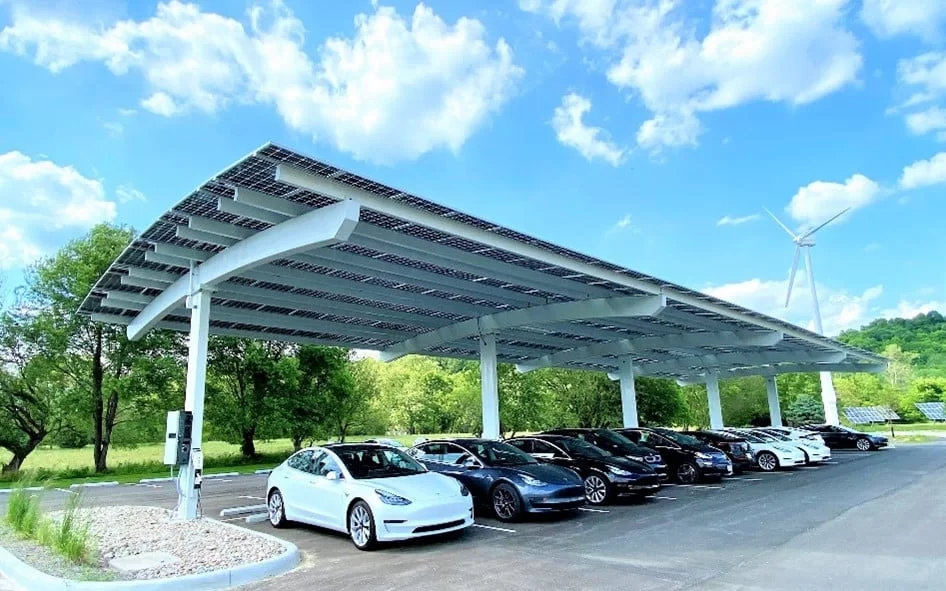
Parking lot solar canopies serve double duty: they generate electricity and provide shaded parking for employees and customers. In Hawaii's sun, shaded parking is a genuine amenity — cars stay cooler and interior surfaces last longer. Retail tenants and hotel guests notice.
Carport structures cost more than rooftop arrays because of the steel support infrastructure, but they add capacity beyond what the building roof can hold. For retail centers and hotels with large parking areas, carports can double the total system size. They also keep panels at optimal tilt angles regardless of roof orientation.
When roof space is limited or structurally constrained, ground-mount arrays use available land adjacent to the facility. This is common on agricultural properties, large industrial sites, and facilities with older roofs that cannot support panel weight. Ground mounts allow optimal tilt angle and easy maintenance access.
From initial assessment to system activation, we manage every step of your commercial solar project.
Energy audit, roof evaluation, shading analysis, electrical infrastructure review. We assess your facility's solar potential and energy profile.
Week 1-2Engineering design, financial modeling with ITC and MACRS, ROI projections, financing options. Detailed proposal with exact costs and savings.
Week 2-4Building permits, electrical permits, HECO interconnection, structural engineering certification. We handle all paperwork and agency coordination.
Week 4-10Our in-house crews install with minimal disruption to your business operations. We coordinate scheduling around your needs.
1-4 weeksCity inspection, HECO meter upgrade, interconnection approval, system commissioning. Permission to Operate (PTO) and you're generating.
Week 2-4 post-installMore installed solar capacity than almost any Hawaii company. We've designed systems from 10 kW to multi-hundred kW. This experience means we get it right the first time.
Our own licensed electricians and installers — not subcontractors. Direct accountability, consistent quality, and crews experienced with commercial-scale projects.
We provide detailed ROI analysis including ITC, MACRS depreciation, SRE export credits, BYOD+ incentives, and financing scenarios so you can make an informed decision.
We schedule around your operations. Weekend and after-hours installation available. Most businesses stay fully operational throughout the installation process.
Need a roof replacement before solar? AC upgrade? EV chargers for your parking lot? Electrical panel upgrade? We handle it all under one contract — one company, one project.
Commercial-grade monitoring with real-time production tracking. Optional maintenance agreements to ensure peak performance and protect your investment long-term.
Yes. For commercial projects placed in service now, the federal credit is generally discussed under Section 48E (Clean Electricity Investment Credit). Many projects can achieve 30% by meeting prevailing wage and apprenticeship requirements. The phaseout begins at the later of 2032 or the statutory emissions threshold. We recommend confirming your specific situation with a CPA.
The Modified Accelerated Cost Recovery System allows businesses to depreciate solar equipment over 5 years (versus the 25-year actual life). The depreciable basis is 85% of the system cost (100% minus half the ITC). With bonus depreciation, a significant portion can be claimed in year one. For a business in the 21% tax bracket, this adds roughly 15-18% of system cost in tax savings on top of the ITC.
Tenants can still go solar with landlord approval. Options include a Power Purchase Agreement (PPA) where a third party owns the system and sells you power at a fixed rate, or a lease arrangement. We can also work with building owners to install solar that benefits tenants. Many landlords see solar as a property value enhancement.
We regularly design and install systems from 10 kW (small office) to 500+ kW (large commercial/industrial). Our 59+ MW total installed capacity demonstrates we have the engineering expertise and crew capacity for projects of any scale. For systems above 1 MW, we partner with specialized EPC firms while managing the local installation.
With Hawaii's high commercial electricity rates ($0.30-$0.45/kWh) and the combined ITC + MACRS benefits, most commercial solar systems in Hawaii achieve payback in 3-5 years. The 25-year return on investment typically exceeds 300-500%. These are among the fastest paybacks anywhere in the United States.
Tax-exempt organizations can't directly claim tax credits, but they can benefit through Power Purchase Agreements (PPAs) where a third-party investor owns the system, claims the credits, and sells power to the nonprofit at a reduced fixed rate. There are also specific grants and programs for nonprofits — we can help identify and apply for these.
Size a system and see ROI projections for your business.
PPA, lease, loan, and cash purchase compared for businesses.
2026 pricing, ITC, MACRS depreciation, and real ROI analysis.
See results from Hawaii businesses and homeowners.
Federal and state incentives are strong now. Start your project while current benefit levels are available.