A Navy E-6 and his wife bought a three-bedroom house in Ewa Beach about four years ago. They were paying HECO around $520 a month, which ate into their BAH more than they expected. We installed a 10 kW system with a Powerwall. Their electric bill dropped to about $30. When he got orders to Virginia two years later, they listed the home and it sold in eleven days — above asking. The buyer’s agent said the solar system and battery were the main reasons it moved so fast. That family did not just save on electricity while they lived there. They walked away with a stronger sale price than any comparable home on the block.
That experience is not unusual, and it highlights something most solar companies in Hawaii overlook entirely: military families are one of the largest homeowner demographics on this island, and their situation comes with specific questions that deserve straight answers.
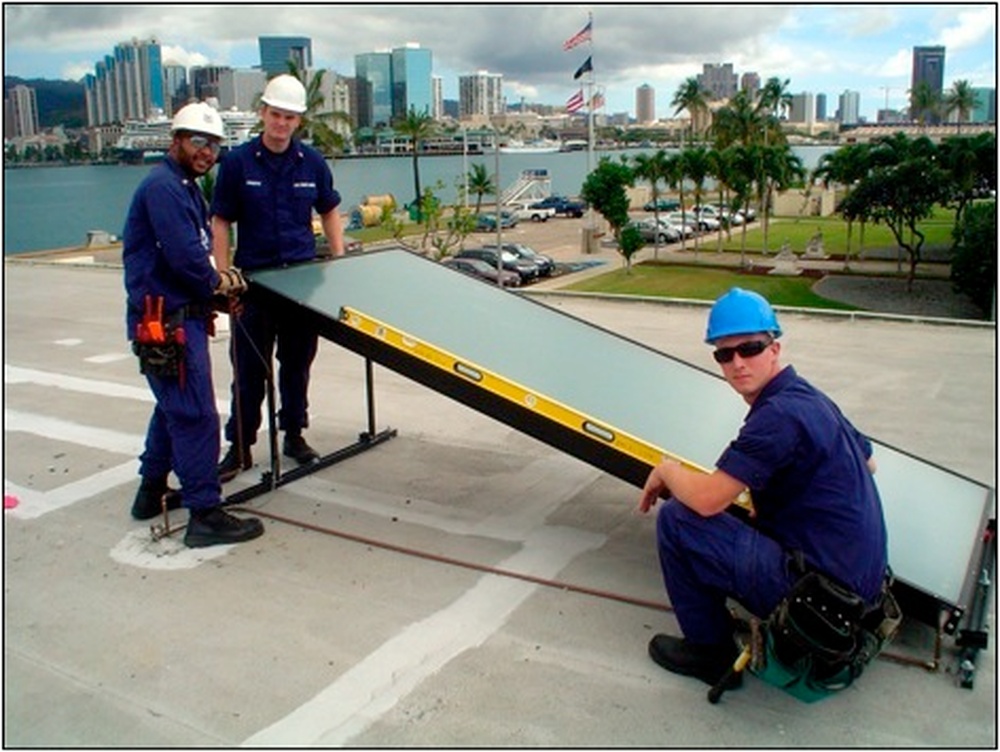
The Military Footprint on Oahu
Oahu has one of the largest military populations per capita of any county in the United States. Joint Base Pearl Harbor–Hickam, Schofield Barracks, Marine Corps Base Hawaii in Kaneohe, Fort Shafter, Camp Smith — these installations and the families they support shape entire neighborhoods across the island. The Department of Defense estimates that military personnel and their dependents make up roughly 10% of Hawaii’s total population.[1] That is not a niche market. It is a significant share of Oahu’s residential housing demand.
Many of these families live off base. They buy homes in Ewa Beach, Kapolei, Mililani, Kailua, and Kaneohe — all neighborhoods with excellent solar exposure and strong grid-tied solar performance. And every single one of them is paying some of the highest electricity rates in the nation.
On-Base Housing: What You Can and Cannot Do
If you live in privatized military housing managed by Lendlease (formerly Forest City), you cannot install solar panels on your roof.[7] The housing company controls the property, and modifications like rooftop solar are not permitted under current agreements. That is the short answer, and there is no workaround.
But that does not mean solar is irrelevant to you. On-base families still pay energy costs through their utility allowances, and understanding how solar works in Hawaii matters for the home you will eventually buy — whether that is here on Oahu or at your next duty station. If you are considering purchasing an off-base home during your time in Hawaii, solar should be part of that financial picture from the start.
Off-Base Homeowners: The Full Opportunity
Military families who buy homes off base have every solar option available to any other Hawaii homeowner. And in the neighborhoods where military families tend to buy, the conditions for solar are particularly good. Ewa Beach and Kapolei sit on the dry, sunny Ewa Plain with minimal cloud cover. Mililani gets consistent sun on its south-facing rooflines. Kailua and Kaneohe, while wetter on average, still produce strong solar yields — we have installed hundreds of systems in windward Oahu neighborhoods that perform well year-round.
The financial case is hard to ignore. A typical three- or four-bedroom home in these areas — the kind of home a military family with kids rents or buys — runs $400 to $800 per month in HECO electricity costs.[2] That is not a typo. Hawaii’s residential electricity rate exceeds $0.40 per kWh, roughly three times the national average. A properly sized solar system drops that bill to $20–$40 per month.
How Solar Interacts with BAH
Your Basic Allowance for Housing is meant to cover rent or mortgage plus typical housing costs, including utilities. On Oahu, BAH rates are among the highest in the military, but so are actual housing costs. When your electric bill runs $500 or $600 a month, that is money straight out of your BAH that is not going toward mortgage principal, savings, or your family.
Solar changes that equation. By cutting your electricity expense by 85–95%, you effectively stretch your BAH further. That is not a creative accounting trick — it is real money back in your monthly budget. For a family paying $550 per month in electricity, solar puts roughly $500 of that back in your pocket every month. Over a three-year PCS tour, that is $18,000 in recovered housing costs.
The PCS Question: What Happens When You Move?
This is the question every military homeowner asks first, and the answer depends entirely on whether you own or lease your system.
If you own the system outright — purchased with cash or through a solar loan — it stays with the house and transfers to the buyer at closing. Research from Lawrence Berkeley National Laboratory found that solar homes sell for approximately 4% more than comparable homes without solar.[3] On a $750,000 Ewa Beach home, that is a $30,000 premium. The system is an asset that makes your property more attractive and more valuable. Warranties from manufacturers like REC and Enphase transfer automatically to the new owner at no cost.
Leased solar is a different story. A lease is a liability, not an asset. The buyer has to qualify for and agree to assume your lease contract, which adds complexity to the closing process. Some buyers refuse outright. Others negotiate a lower sale price because of it. If the buyer will not assume the lease, you may have to buy it out before closing — and buyouts typically run $10,000 to $25,000.
My professional opinion on this is straightforward: if you are a military homeowner who knows you will PCS within two to four years, buy your system. Do not lease. An owned system adds home value, transfers cleanly, and does not create complications at closing. A leased system can turn your sale into a headache at exactly the moment you need it to go smoothly — when you are packing up your household and reporting to a new duty station on a hard deadline.
VA Loans and Solar Financing
The VA home loan is one of the best benefits of military service, but it does not directly cover solar panel installation as an add-on to your purchase. You cannot roll a $30,000 solar system into a standard VA purchase loan.
That said, there are workable paths. The VA Energy Efficient Mortgage (EEM) program allows borrowers to add up to $6,000 in energy-efficiency improvements to their VA loan — or more if the improvements meet certain cost-effectiveness tests.[4] For a full solar installation, the EEM may cover only a portion of the cost, but it reduces the amount you need to finance separately.
The more common approach is to finance solar through a dedicated solar loan alongside your VA mortgage. These are separate obligations, and they work fine together. Solar loan terms typically run 15–25 years with competitive rates, and the monthly payment is almost always less than the electricity cost it replaces. A family paying $500 per month to HECO that switches to a $150 per month solar loan payment is still $350 ahead every month from day one.
The Timeline Math: PCS Cycles vs. Solar Payback
Here is the honest math. A typical Hawaii PCS assignment runs two to three years. Solar system payback in Hawaii — accounting for the Hawaii 35% state tax credit — is roughly five to seven years.[5] So yes, if you sell within your PCS cycle, you will not reach full payback through electricity savings alone.
But that is not the complete picture. You recover value through three channels simultaneously. First, the monthly savings from the day the system activates — $300 to $500 per month in avoided HECO charges. Second, the home value premium at sale — roughly 4% above comparable homes.[3] Third, the Hawaii property tax exemption under HRS §246-34.5, which means your solar system adds market value without increasing your tax assessment.[6]
When you add those together, most military homeowners who buy a system and sell within two to three years come out ahead or close to even — and that is before counting the quality-of-life improvement of not worrying about a $600 electric bill every month.
Battery Storage and Grid Independence
Service members understand preparedness in a way that most homeowners do not. A solar-plus-battery system is the residential version of that thinking. When the grid goes down — whether from a storm, equipment failure, or any other cause — a Tesla Powerwall keeps your refrigerator running, your lights on, and your family comfortable.
Oahu does experience power outages, and they are not always short. A battery system rated at 13.5 kWh (one Powerwall) can keep a typical home running through the night and recharge from solar the next morning. Two Powerwalls provide enough capacity to power most homes through extended outages without rationing.
There is also a practical consideration specific to military families. If you are deployed or TDY and your spouse is managing the household alone, a battery backup system means one less thing to worry about during a power outage. That peace of mind has real value, even if it does not show up on a spreadsheet.
What We Have Learned from Military Homeowners
Over 33 years and more than 10,000 installations, we have worked with military families in Ewa Beach, Kapolei, Kailua, Kaneohe, Mililani, and every other neighborhood where service members put down roots. The patterns are consistent: timeline pressure from PCS cycles, financing questions around VA loans, and the non-negotiable need for a system that adds value when you sell rather than creating complications.
We will not recommend a lease to a military homeowner. We will not size a system using mainland assumptions that ignore Hawaii’s rate structure. And we will not stretch a straightforward project into a drawn-out sales process — military families have enough to manage without that.
If you are stationed on Oahu, living off base, and paying HECO rates on a home you own, the numbers are worth 15 minutes of your time. Request a free assessment, or run your own estimate with our solar savings calculator.
Sources & References
- U.S. Department of Defense — military personnel and dependents in Hawaii demographics. Department of Defense
- Hawaiian Electric residential rate schedules — among the highest in the nation at over $0.40/kWh. Hawaiian Electric
- Lawrence Berkeley National Laboratory study of 22,000+ home sales finding ~4% solar premium. LBNL
- U.S. Department of Veterans Affairs — Energy Efficient Mortgage (EEM) program overview. VA.gov
- Hawaii State Energy Office and SEIA — typical residential solar payback periods in Hawaii. SEIA
- Hawaii Revised Statutes §246-34.5, property tax exemption for solar energy systems. Hawaii State Legislature
- Lendlease (Island Palm Communities / Hickam Communities) — privatized military housing management and resident policies. Island Palm Communities