If you have snorkeled Hanauma Bay in the last ten years, you already know something is wrong. The coral heads that old-timers remember as sprawling forests of brown and purple are paler now, patchier, with stretches of bare white skeleton where living tissue used to be. Kaneohe Bay, once so degraded from sewage runoff that scientists wrote it off, staged a remarkable recovery over decades — only to face a threat it cannot adapt to fast enough.
The threat is not local pollution. Kaneohe’s water quality is better than it has been in fifty years. The threat is global atmospheric CO2 dissolving into seawater and changing the chemistry that corals depend on to build their skeletons. And in Hawaii, a disproportionate fraction of that CO2 comes from burning petroleum to generate electricity.
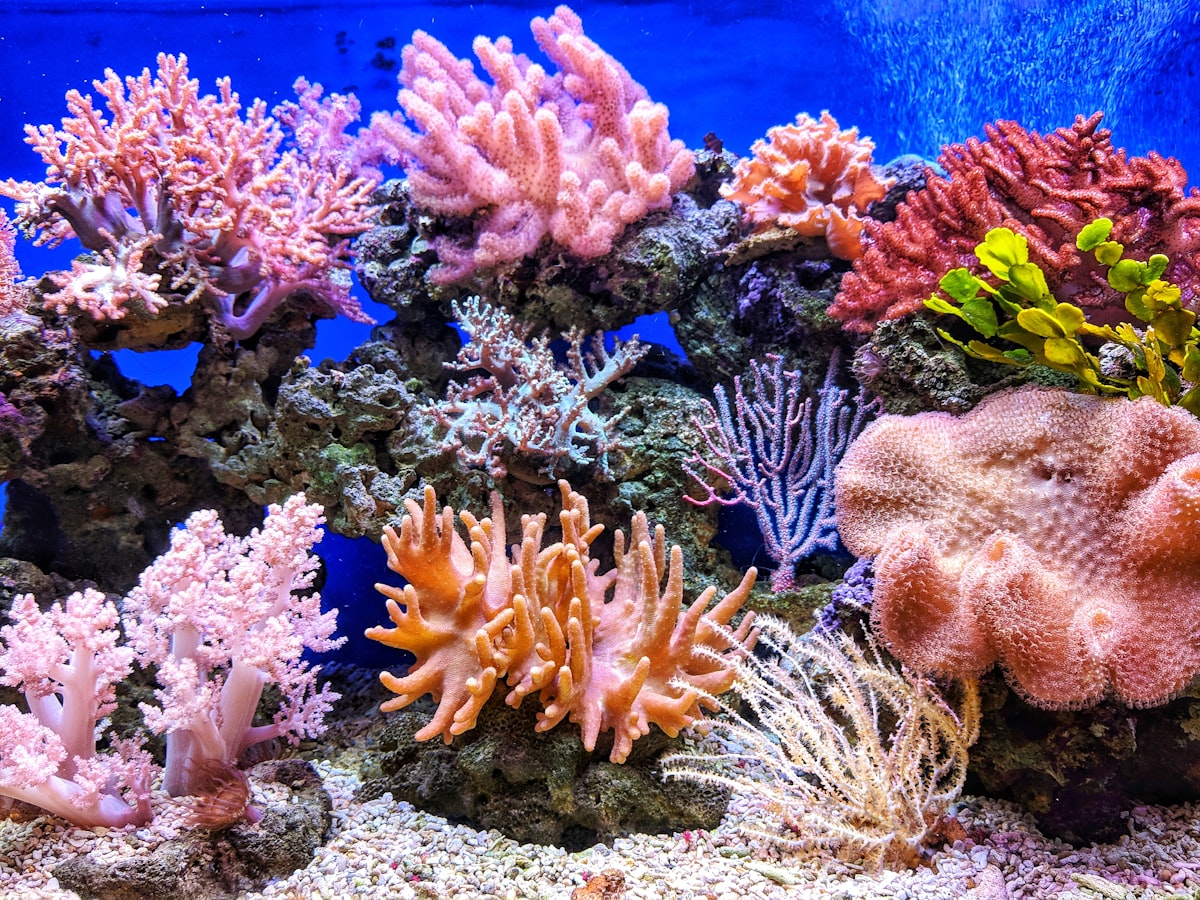
The Carbonate Chemistry
The ocean absorbs roughly 25 to 30 percent of anthropogenic CO2 emissions.[1] The Pacific basin is the largest carbon sink on Earth. When CO2 dissolves in seawater, it undergoes a well-characterized reaction sequence: CO2 + H2O → H2CO3 (carbonic acid) → H+ + HCO3− (bicarbonate) → 2H+ + CO3²− (carbonate). The increase in hydrogen ions (H+) lowers the pH. The simultaneous reduction in carbonate ion (CO3²−) concentration is what directly affects calcifying organisms.
Corals build their skeletons by extracting calcium and carbonate ions from seawater to form aragonite, a crystalline form of calcium carbonate (CaCO3). When carbonate ion concentration drops, the saturation state of aragonite (Ωarag) decreases. Below a saturation state of approximately 3.0, coral calcification rates decline measurably. Below 2.0, reef accretion — the process by which reefs grow upward faster than they erode — may cease entirely.[2]
Ocean pH has dropped approximately 0.1 units since the pre-industrial era, from about 8.2 to 8.1. The pH scale is logarithmic: that 0.1 unit change represents a 26 percent increase in hydrogen ion concentration.[3] For organisms that evolved over millions of years in remarkably stable water chemistry, this is not a gradual shift. It is a step change occurring within a single human lifespan.
The tropical Pacific, where Hawaii sits, is particularly vulnerable because warm water holds less dissolved CO2 at equilibrium — meaning a given atmospheric CO2 increase produces a larger relative change in carbonate chemistry in tropical waters than in cold polar waters. Hawaii’s reefs are experiencing acidification faster than the global average.
What the Bleaching Record Shows
Hawaii’s reef system spans roughly 1,400 miles from the main Hawaiian Islands to Kure Atoll in the Northwestern chain. It supports approximately 7,000 marine species, at least 25 percent of which are found nowhere else on Earth.[4] The reefs break wave energy by 80 to 97 percent, protecting shoreline infrastructure from storm surge. They sustain fish populations that have fed Hawaiian communities for centuries. They underpin a marine tourism economy worth billions annually. For Native Hawaiians, the reef is not separate from the culture. It is part of it.
The bleaching timeline tells a story of accelerating frequency:
In 1996, scientists documented the first significant bleaching event in Kaneohe Bay — notable at the time but considered recoverable. In 2014 and 2015, back-to-back marine heatwaves drove the most severe bleaching event in Hawaii’s recorded history. Divers at Lisianski and Pearl and Hermes Atoll in the Northwestern chain documented 50 to 90 percent bleaching.[5] Nearshore reefs along the Kona coast and in West Maui showed widespread tissue loss. In 2019, another round concentrated along West Hawaii. Then 2023 and 2024 brought the fourth global mass bleaching event, with ocean temperatures in the central Pacific reaching unprecedented levels.[6]
The pattern is not random. It correlates directly with rising sea surface temperatures driven by accumulated greenhouse gases. The recovery window between events is shortening. Reefs that historically had 15 to 25 years between major thermal stresses are now getting hit every 3 to 6 years. Below a certain frequency threshold, recovery becomes impossible — the reef degrades into an algae-dominated state from which it does not return.
Hawaii’s Petroleum Problem
Hawaii is the most petroleum-dependent state in the nation for electricity generation.[7] Hawaiian Electric operates oil-fired power plants on Oahu (Kahe, Waiau, and the recently retired Campbell Industrial facility), Maui (Maalaea), and Hawaii Island (Keahole, Hill, Puna). These plants burn low-sulfur fuel oil and diesel to produce electricity at a grid-average carbon intensity of approximately 650 grams of CO2 per kilowatt-hour — roughly double the national average and triple the rate of states with significant natural gas or nuclear generation.
A typical Oahu household consuming 600 kWh per month is responsible for approximately 4.7 metric tons of CO2 annually from electricity alone. That CO2 enters the atmosphere from plant stacks on the Leeward coast, mixes into the same atmospheric column that sits above the same Pacific Ocean that washes against the reefs you can see from Ko Olina, Waikiki, or Kailua Beach.
On the mainland, CO2 from a power plant in Ohio has a diffuse, abstract relationship with the nearest coastline. In Hawaii, the distance from smokestack to reef is measured in single-digit miles. The atmospheric residence time of CO2 is long enough that local emissions become globally distributed, but the psychological and geographic proximity in Hawaii makes the connection unusually direct and visceral.
The Legislative Response: Hawaii’s Renewable Energy Framework
Hawaii’s legislators understood this connection earlier than most. The legislative response has been the most aggressive renewable energy framework in the United States — built not from abstract environmentalism but from the practical recognition that an island state surrounded by coral reefs, dependent on imported petroleum, and facing the highest electricity rates in the nation had compelling economic, security, and ecological reasons to decarbonize its grid.
The Clean Energy Initiative (2008)
In 2008, the State of Hawaii and the U.S. Department of Energy signed a Memorandum of Understanding establishing the Hawaii Clean Energy Initiative (HCEI).[8] The agreement set an initial goal of 70 percent clean energy by 2030 (40 percent from renewables, 30 percent from efficiency). It was unprecedented at the time — no other state had committed to anything close.
The 100% Renewable Portfolio Standard (2015)
In 2015, Governor David Ige signed House Bill 623 into law, making Hawaii the first state in the nation to mandate 100 percent renewable electricity.[9] Codified in HRS §269-92, the law established a binding renewable portfolio standard (RPS) with interim milestones:
| Year | RPS Target |
|---|---|
| 2020 | 30% |
| 2030 | 40% |
| 2040 | 70% |
| 2045 | 100% |
Hawaii met the 2020 target. As of 2025, the state’s renewable fraction is approximately 38 to 40 percent, driven largely by distributed rooftop solar, utility-scale wind and solar farms, and geothermal generation on the Big Island.
The Paris Agreement Commitment (2017)
When the federal government withdrew from the Paris Climate Agreement in 2017, Hawaii became the first state to enact legislation formally committing to Paris Agreement goals.[10] Act 32 (2017) codified the state’s commitment to the agreement’s emissions-reduction targets, explicitly linking energy policy to climate impact.
Net-Negative Emissions Target (2018)
Hawaii went further than any other state with HRS §225P-5, which establishes a goal to sequester more atmospheric carbon and greenhouse gases than the state emits — net-negative emissions — as quickly as practicable, but no later than 2045.[11] This is not merely carbon-neutral. It is a mandate to become a net carbon sink.
Economy-Wide Decarbonization (2022)
Act 238 (2022) tasked the Hawaii State Energy Office with analyzing pathways and developing recommendations for achieving economy-wide decarbonization — extending the mandate beyond electricity generation to transportation, industry, and agriculture.[8]
Reef Protection Legislation
In a direct acknowledgment of the reef-climate connection, Hawaii banned the sale of sunscreens containing oxybenzone and octinoxate in 2018 (Act 104, effective January 2021), making it the first jurisdiction in the world to do so.[12] While sunscreen chemicals are a local stressor distinct from CO2, the legislation demonstrated that Hawaii’s political framework treats reef health as a policy priority warranting aggressive action.
The DLNR Division of Aquatic Resources manages Hawaii’s coral reef conservation program, coordinates reef monitoring, and administers marine protected areas. The Department has increasingly framed climate change and ocean acidification as the dominant long-term threats to reef health — threats that cannot be addressed by local water quality management alone but require atmospheric carbon reduction.
What One Solar Rooftop Changes
A typical 8 to 12 kW residential solar system on Oahu offsets most or all of a household’s grid electricity consumption. Against Hawaii’s petroleum-heavy grid, that translates to 4 to 8 metric tons of CO2 avoided per year. Over the 25-year warranted life of the panels: 100 to 200 metric tons of CO2 that never enters the atmosphere and never dissolves into the Pacific.
One home does not save the reef. The physics does not allow that claim. Global atmospheric CO2 passed 425 ppm in 2024 and continues rising. The thermal inertia of the ocean means warming will continue for decades even if emissions stopped tomorrow. Hawaii’s reefs face stress that no amount of local solar installation can fully reverse.
But Hawaii has approximately 400,000 residential electricity accounts. If a meaningful fraction of those homes go solar, the aggregate reduction is measured in millions of metric tons over the coming decades. And because Hawaii displaces some of the dirtiest generation in the country — petroleum at 650 g CO2/kWh versus the national average of ~400 g — every kilowatt-hour of solar on a Hawaii rooftop achieves roughly 60 percent more carbon reduction than the same panel would on a mainland rooftop connected to a gas-and-renewables grid.
As of 2025, approximately 36 percent of HECO’s residential customers on Oahu have rooftop solar. That penetration rate is the highest in the nation and represents an estimated 1.5 to 2 million metric tons of annual CO2 avoidance. The remaining 64 percent of homes represent an opportunity to roughly double that figure.
The Compounding Stressors
Scientific honesty requires acknowledging that CO2 is not the only threat. Hawaii’s reefs face a convergence of stressors that interact in complex ways:
Ocean acidification reduces calcification rates and weakens existing reef structure. Thermal stress causes bleaching events that kill coral tissue. Sedimentation from coastal development and erosion smothers coral and blocks light. Nutrient runoff from agricultural and urban areas feeds algal growth that competes with coral for space. Invasive species — particularly certain algae introduced through ship ballast water — overgrow native reef communities. Fishing pressure removes herbivorous fish that control algae growth, disrupting the reef’s ecological balance.
Addressing CO2 through renewable energy is necessary but not sufficient. It is one intervention in a system that requires multiple concurrent interventions. The difference is that CO2 reduction is the only intervention that addresses the two largest threats — acidification and thermal stress — simultaneously. Sediment control, runoff management, and fisheries regulation address important but secondary stressors. Without reducing atmospheric CO2, the primary drivers of reef decline continue regardless of how well local stressors are managed.
This is why the legislative framework matters. Hawaii’s 100% renewable mandate, net-negative emissions target, and Paris Agreement commitment are not symbolic gestures. They are the policy architecture for the most consequential environmental intervention the state can make on behalf of its marine ecosystems.
The Island Calculus
On the mainland, the argument for solar is primarily economic: reduce your electricity bill, increase your home value, hedge against rate increases. Those arguments hold in Hawaii too — with even more force given HECO’s $0.41/kWh residential rate.
But there is a dimension here that mainland homeowners do not experience. The reef off your beach is not an abstraction. The fish your family eats comes from water whose chemistry is changing because of the power plant you can see from the freeway. The storm surge that threatens your property is absorbed by a reef system whose structural integrity is declining because of the CO2 in the atmosphere — CO2 that your electricity consumption contributed to.
Going solar in Hawaii is an economic decision. It is also, unavoidably, a marine conservation decision. Not because installing panels makes you an environmentalist — but because the atmospheric physics does not distinguish between your motivations. The CO2 that does not enter the atmosphere because your roof generates electricity instead of the Kahe plant is CO2 that does not dissolve into the water at Hanauma Bay.
The connection is direct, measurable, and supported by the same atmospheric science that underpins every climate model in the IPCC assessment reports. It is not marketing. It is chemistry.
If the health of Hawaii’s marine environment matters to you — alongside the economics of a $0.41/kWh rate — we would welcome the conversation about what a solar system looks like for your home. You can also run the numbers yourself with our solar calculator.
Sources & References
- Friedlingstein, P., et al. Global Carbon Budget 2024. Ocean CO2 uptake estimates. NOAA Pacific Marine Environmental Laboratory
- Hoegh-Guldberg, O., et al. Coral reefs under rapid climate change and ocean acidification. Aragonite saturation thresholds. Science (2007)
- Ocean acidification: 26% increase in hydrogen ion concentration since pre-industrial era. NOAA Ocean Acidification Program
- Hawaii marine species biodiversity and endemism rates. Hawaii DLNR Division of Aquatic Resources
- 2014-2015 Hawaii coral bleaching event documentation. NOAA Coral Reef Watch
- Fourth global mass coral bleaching event, 2023-2024. NOAA Coral Reef Watch
- Hawaii electricity generation fuel mix and carbon intensity. EPA eGRID
- Hawaii Clean Energy Initiative and Act 238 (2022) economy-wide decarbonization. Hawaii State Energy Office
- HB 623 (2015) establishing 100% renewable portfolio standard. HRS §269-92. Hawaii State Legislature
- Act 32 (2017) committing Hawaii to Paris Agreement climate targets. Hawaii State Legislature
- HRS §225P-5 establishing net-negative emissions target by 2045. Hawaii State Legislature
- Act 104 (2018) banning oxybenzone and octinoxate sunscreens. Hawaii State Legislature