A homeowner in Waianae sat across from us at a consultation last year and said, "I want to be completely off the grid. I am done with HECO." We hear some version of that every week. And we get it. After years of $400+ electric bills and another round of rate increases, cutting the cord sounds like freedom.
Then we showed him the numbers. A true off-grid system for his four-bedroom home with AC and an electric water heater would run about $95,000. A hybrid system — solar plus a battery, still connected to the grid but using far less of it — would cost much less and still deliver backup power during outages, evening self-consumption, and a very small HECO bill. He went hybrid. Almost everyone does, once the conversation shifts from emotion to engineering.
Grid-Tied: The Budget Option
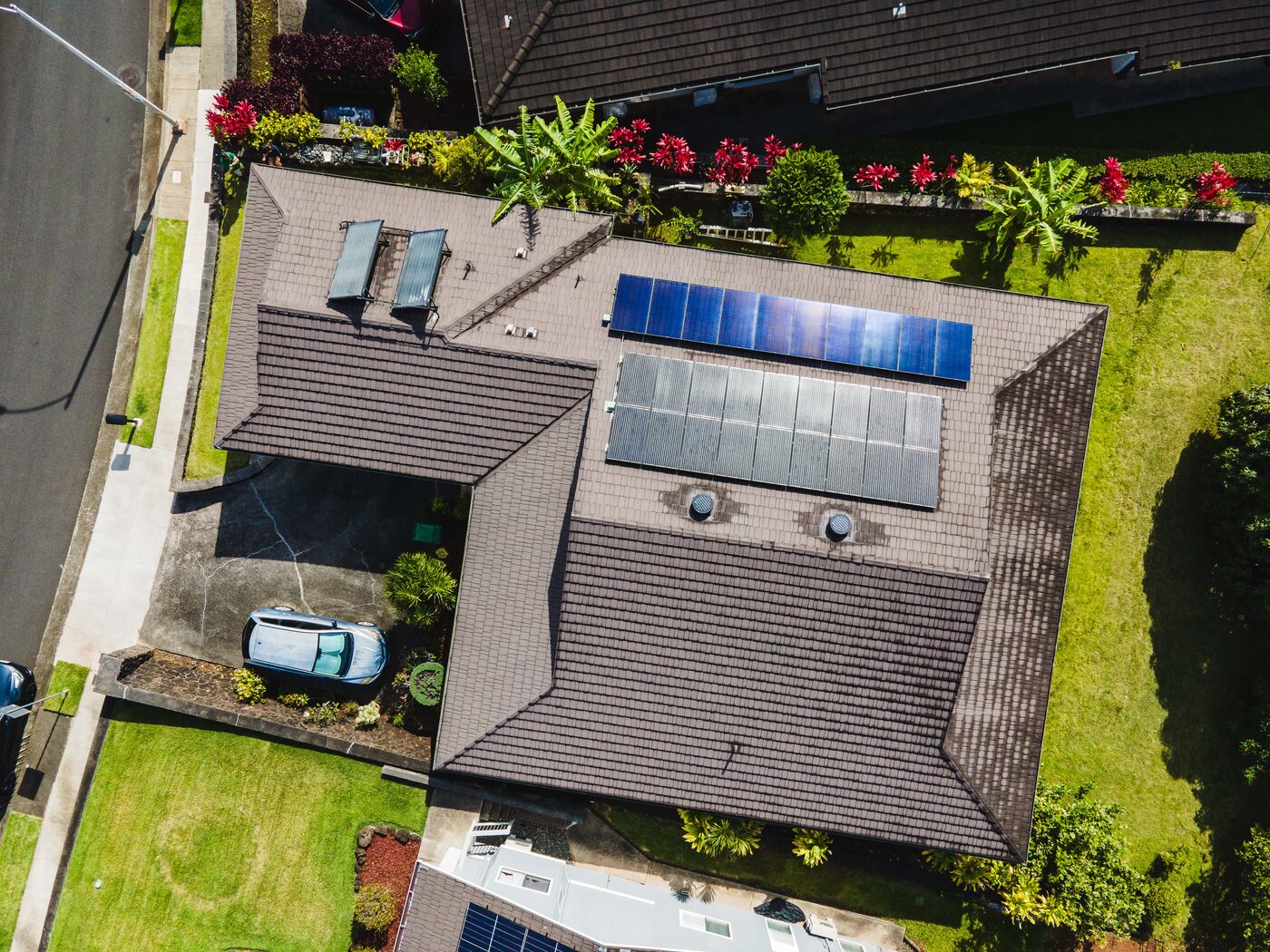
A grid-tied system is the simplest design. Solar panels connect to HECO's grid through an inverter. When your panels produce more than you use, excess flows to the grid. When you need more than your panels produce — at night, on cloudy days, or during dinner-hour spikes — you pull from the grid. No battery. No backup.
For most new Hawaii installs, that means enrolling in one of Hawaiian Electric's Smart Renewable Energy programs. Smart Renewable Energy Export lets you send excess power to the grid for bill credits. Smart Renewable Energy Non-Export keeps the system from sending power back at all.[1] Either way, a battery-free system still depends on the grid when the sun is down.
The upside is cost. A 10 kW grid-tied system runs about $25,000–$32,000 installed, with a simpler design, fewer components, and less maintenance. You still save significantly on electricity. But you get zero power during grid outages — the system shuts down when the grid goes down, which is a safety requirement, not a design flaw.[1] You also cannot move cheap daytime solar into the expensive evening hours, which is where batteries earn their keep in Hawaii.
Off-Grid: The Fantasy That Rarely Pencils Out
An off-grid system disconnects from HECO completely. Your panels charge a large battery bank, and you draw all your power from those batteries. No utility connection. No monthly bill. No grid dependency.
It sounds great until you design one.
Off-grid systems need significantly oversized solar arrays to handle cloudy stretches and seasonal variation. They need massive battery banks — 40–80+ kWh for a typical home, compared to the single 13.5 kWh Powerwall[2] that handles many hybrid installations. Most off-grid homes also need a backup generator for extended low-production periods. The system has to be designed for your worst week, not your average Tuesday.
For a typical 3–4 bedroom Hawaii home with AC and an electric water heater, a true off-grid system runs $70,000–$120,000+. Battery replacement every 10–15 years adds another $15,000–$30,000. And you have to manage your usage carefully — no unlimited grid to save you if the dryer, the AC, and the oven all hit at once on a cloudy afternoon.
Off-grid makes sense in one specific scenario: when grid connection is unavailable or prohibitively expensive. Remote agricultural land on the Big Island. A property in the hills where running utility lines would cost $50,000. In those cases, off-grid is not a statement. It is the only practical option. For a home already connected to HECO's grid, the economics almost never work.
Hybrid: What Most People Actually Want
A hybrid system stays connected to HECO's grid and adds battery storage. You get grid access when you need it, battery backup when the grid fails, and the ability to store daytime solar energy for use at night. It is the system that best matches how most Hawaii families actually live.
During the day, your panels power your home and charge your battery. When the battery is full, excess energy exports to the grid for SRE credits. In the evening, instead of buying expensive grid power, you draw from your battery. During an outage, the battery keeps your critical loads running — lights, refrigerator, internet, and in some homes even AC. A Tesla Powerwall 3 provides 13.5 kWh of backup,[2] enough for roughly 10–24 hours depending on what you are running. With solar recharging the battery each day, you can ride out multi-day outages without living in the dark.
A 10 kW system with a Powerwall 3 typically runs $38,000–$48,000 installed. Federal tax credits and HECO battery incentives can reduce that number meaningfully, but the exact net cost depends on your tax situation, system size, battery configuration, and whether you qualify for additional state incentives. The point is not that hybrid is cheap. It is that hybrid usually costs far less than true off-grid while delivering most of the benefit people actually care about.
Why Hybrid Wins for Most Hawaii Homes
The financial incentives are stacked in hybrid's favor right now. Qualifying solar-and-battery systems may be eligible for the federal Residential Clean Energy Credit, and standalone battery systems may qualify as well under current IRS rules.[4] On the utility side, Hawaiian Electric's BYOD Plus program currently offers an upfront incentive of $400 per kW committed, plus monthly export credits, for qualifying battery systems.[1] That combination materially improves the math for solar paired with storage. Because tax treatment can change, confirm current eligibility before relying on a proposal, but the broad direction is clear: batteries are being rewarded, not ignored.
The self-consumption math is equally compelling. Hawaiian Electric's current Smart Renewable Energy Export rates for Oahu pay much less during the daytime than the value of avoiding retail purchases later in the evening.[1] Every kilowatt-hour you store and use after sunset is usually worth far more than one you export at midday. A battery changes the economics of solar by putting your production to work when power is most expensive and when your family actually needs it.
And then there is resilience. Hawaii faces hurricanes, tropical storms, and the occasional grid failure that knocks out power for hours or days. A family in Kapolei with a Powerwall rode out a 36-hour outage last year without losing a single item in their refrigerator. Their neighbors were buying ice and calling hotels. That peace of mind is hard to price precisely, but it becomes very real the first night the neighborhood goes dark.
Hybrid gives you most of the resilience people want from off-grid at a fraction of the cost. You maximize your solar investment. You keep the grid as an unlimited safety net. And you do not have to run your household like a campsite every time the weather turns.
Side by Side
| Feature | Grid-Tied | Off-Grid | Hybrid |
|---|---|---|---|
| Upfront Cost | $$ | $$$$ | $$$ |
| Backup Power | No | Yes | Yes |
| Battery Incentive Fit | Weak | Varies | Strong |
| HECO Program Fit | SRE Export or Non-Export | Not grid-dependent | SRE plus BYOD Plus |
| Evening Self-Use | No | Yes | Yes |
| Best For | Tight budget | Remote sites | Most homes |
How to Decide in 60 Seconds
Choose grid-tied if your main goal is lowering the upfront cost and you are comfortable having no backup during outages.
Choose off-grid only if utility service is unavailable, unreliable enough to be unusable, or so expensive to extend that a large battery bank and generator actually make financial sense.
Choose hybrid if you want the practical middle ground: strong savings, outage protection, access to HECO programs, and a system that still behaves like a normal house when real life happens.
The Short Version
For the vast majority of Oahu homeowners, a hybrid system with solar panels and a battery such as a Tesla Powerwall 3 is the right call. The incentives support it, the economics favor self-consumption, and the backup power matters more than most homeowners realize until the first outage hits.
If budget is extremely tight, go grid-tied and design the system so a battery can be added later. If you are building on remote land with no practical utility access, off-grid may be the correct answer. But if you already have HECO available and you want the best balance of savings, resilience, and sanity, hybrid is the answer.
Sources & References
- Hawaiian Electric (HECO), Smart Renewable Energy Export, Smart Renewable Energy Non-Export, and BYOD Plus program details. Hawaiian Electric
- Tesla Powerwall 3 product specifications, capacity, and warranty terms. Tesla
- National Renewable Energy Laboratory, Grid-Tied vs. Off-Grid Solar System Analysis. NREL
- Internal Revenue Service, Residential Clean Energy Credit guidance including battery storage eligibility. IRS
- Solar Energy Industries Association, U.S. Solar Market Insight and storage deployment data. SEIA